
 Mask fields
Description
Mask fields replaces the values of the fields you list. Each field names a Masking pattern, and the pattern decides what is written.
The field keeps its name and its type. A string stays a string, and a number stays a number.
Null and empty values are left as they are when the pattern builds a token. A missing value does not become a person. SET_NULL and SET_EMPTY always write.
The same pattern shares one mapping. Matt in two fields that use First name becomes the same token. Use a second pattern when those fields need different tokens.
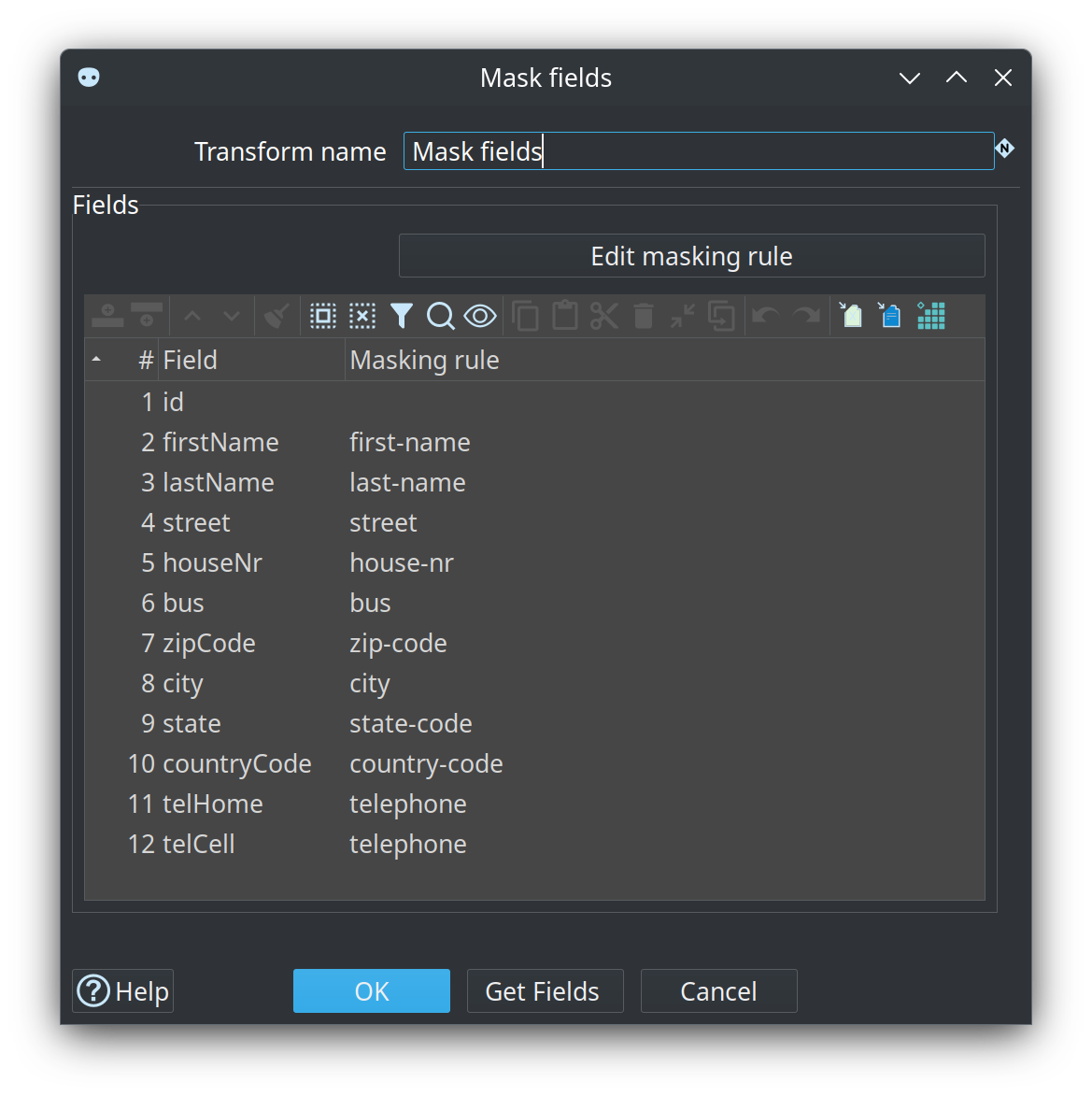
Options
| Option | Description |
|---|---|
Transform name |
Name of the transform. This name has to be unique in a single pipeline. |
Get fields |
Adds a row for each incoming field. |
Edit masking rule |
A masking rule is a Masking pattern, edited in the metadata perspective. With a row selected, edits that row’s rule, or creates one when the row has none. With no row selected, opens the Masking pattern type in the metadata perspective. |
Field |
Field whose value is replaced. A row with no masking rule is left unchanged. |
Masking rule |
Name of a Masking pattern metadata item. Leave this empty to skip the field. |
When a field cannot be masked and the transform has error handling, the error row has that field and every masked field after it set to null.
What a pattern writes
SYNTHETIC builds prefix + token + suffix for a string. The token is a SEQUENCE (an integer that starts at Sequence start and steps by one) or a UUID. A number field can take a sequence only, with an empty prefix and suffix. A date cannot take a generated token.
SET_NULL writes null. SET_EMPTY writes a blank string and applies to string fields only.
Remembering values
NONE assigns a value on every row. A new run starts again.
MEMORY keeps the mapping for this pipeline execution. The next run starts again, so tokens from the previous run can be issued again.
DATABASE keeps the mapping in the table named on the pattern. A second table, that name plus _seq, stores the next sequence number. Both tables are created when they are missing. The map table has pattern_name, source_key and masked_value, with a primary key on the pattern name and the source key. A new map table also has a unique key on the pattern name and the masked value, and holds masked values of up to 255 characters.
Give a database pattern a Hash secret. The map table then stores an HMAC-SHA256 of each value, made with that secret, instead of the value itself. Without a secret, source_key holds the original value, so the table is itself personal data, and the transform check warns about it. Keep the secret in a variable, out of the project. Changing the secret starts a new mapping. A row stored in plain text before the pattern had a secret is moved to its hashed key the next time its value is masked. Rows for values that do not come by again stay in plain text, so delete those once the mapping has been rebuilt.
Several Hop processes can share one map table. Each new sequence number is reserved with a row lock, so two processes never hand out the same value.
Ignore surrounding spaces and Ignore case make values that only differ in those ways share a replacement. A number is compared by its value, not by its conversion mask. Turning these options on for a database pattern that already holds mappings changes replacements: spellings such as Matt and matt that had their own replacement now share the one stored for whichever spelling comes by first, so data masked earlier no longer matches for the others.
A hash secret that resolves to nothing, or still holds a variable that is not set, stops the transform from starting. It never falls back to plain text or to the literal text of the variable.
Copies and partitions of one pipeline share one runtime, so a remembered value stays the same and a sequence does not start over on each copy. Which row receives which new sequence number follows whichever copy runs first. Beam and native Spark each run a worker in its own JVM, so they stay unsupported. The database store is what shares a mapping across pipelines. Copies share a database store when its connection resolves to the same URL and user.